Best Time for a Barcelona Helicopter Tour: Month-by-Month Weather Guide
When to book a Barcelona helicopter tour — month-by-month weather, Tramontana wind windows, summer haze, and the slot that consistently outperforms the rest.
Barcelona’s Mediterranean climate sounds like a year-round green light for a helicopter tour from the harbour heliport — and it mostly is. But three weather variables decide whether your booked slot actually flies and whether the photos are usable: visibility (haze in summer mornings), the Tramontana wind (the cold northerly that grounds tourist flights when it blows hard), and the daylight window (sunset helicopter slots aren’t on offer, so winter shortens the bookable day). This guide walks through each month, the slot mechanics, and the festival weeks where the city books up around you.
The short answer
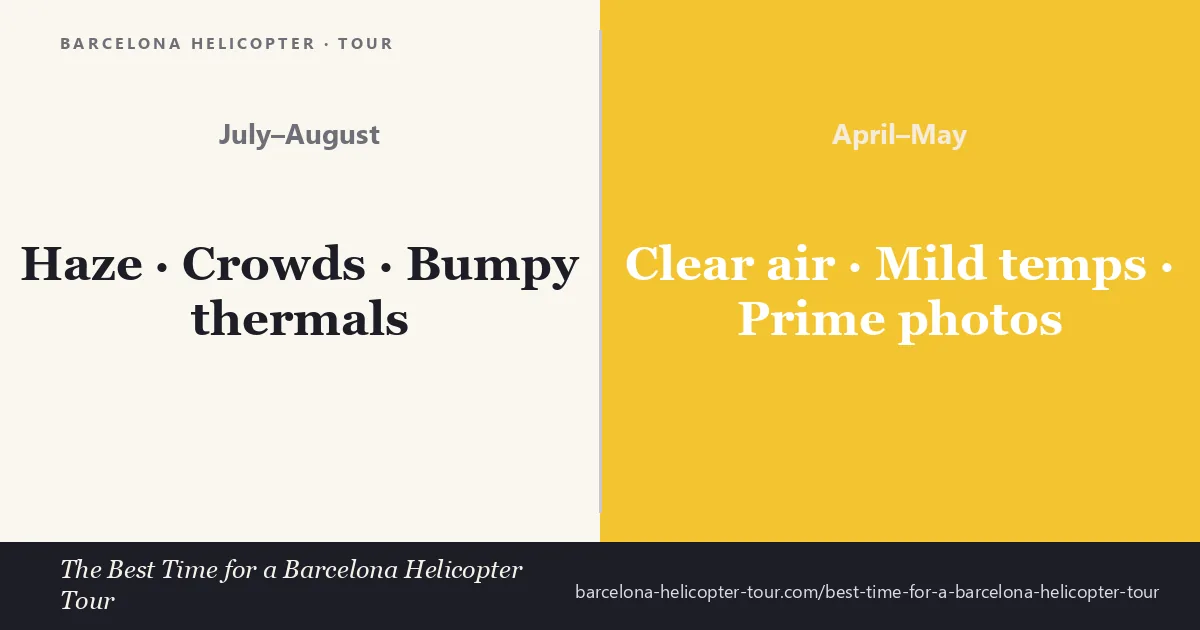
For the best combination of clear visibility, comfortable cabin temperatures, and lowest wind-cancellation risk, late April to mid-June and mid-September to late October are the prime windows for a Barcelona helicopter tour. July and August fly daily but afternoon haze and crowds at the heliport dent the experience. November to March still flies routinely, with shorter days and a higher Tramontana cancellation risk that the operator manages with free 24-hour rebooking.
Barcelona weather, month by month
Barcelona sits on the Mediterranean coast at roughly 41° north — about the same latitude as Boston, with very different weather. The city averages around 2,500 hours of sunshine a year and rarely sees freezing temperatures. The two pressures on helicopter flights are summer humidity (which softens distance visibility) and the autumn–winter Tramontana wind (which can ground flights for half a day).
| Month | Avg high (°C / °F) | Rainfall days | Helicopter notes |
|---|---|---|---|
| Jan | 13 / 55 | 6 | Coolest. Shorter daylight; flights run in both slots; pack a windproof jacket |
| Feb | 14 / 57 | 5 | Quietest visitor month; same daylight constraint as Jan |
| Mar | 16 / 61 | 6 | Spring tilts in; visibility improving |
| Apr | 18 / 64 | 7 | Prime window opens. Clear air, mild cabin temps |
| May | 21 / 70 | 6 | Peak. Warm but not haze-heavy yet |
| Jun | 25 / 77 | 4 | Excellent except for late-morning coastal haze |
| Jul | 28 / 82 | 2 | Driest month; afternoon haze peaks; heliport busier |
| Aug | 28 / 82 | 4 | Same as July; family-holiday crowds at slots |
| Sep | 26 / 79 | 7 | Second prime window opens. Light tilts golden |
| Oct | 22 / 72 | 9 | Peak fall. Best post-Tramontana visibility days |
| Nov | 17 / 63 | 6 | Tramontana risk rises; shorter daylight; quieter |
| Dec | 14 / 57 | 6 | Coolest with Jan; flights run; check forecast morning of |
The numbers are typical climate-normal averages — published Mediterranean-climate data for Barcelona’s coastal location. Individual days swing widely either way, especially around the Tramontana windows in late autumn.
The Tramontana — Barcelona’s helicopter wild card
The Tramontana is a cold, dry, gusty wind that descends from the Pyrenees and the Massif Central into Catalonia and rolls out over the Mediterranean. It blows in distinct events lasting one to four days, peaks most often between October and April, and is the single biggest weather reason a Barcelona helicopter flight gets rescheduled.
Two paradoxes make it worth understanding:
- The Tramontana clears the air. When it stops, the day or two of calm that follows is often the highest-visibility window of the entire month. Photographers who can rebook flexibly chase post-Tramontana mornings deliberately — Sagrada Família from above on a post-Tramontana day is the city’s clearest helicopter shot of the year.
- It does not always mean cancellation. Tourist sightseeing helicopters operate within strict ground-wind ceilings set by the operator and aviation authorities. The exact threshold varies by aircraft type and is reset on a per-day basis. When the wind exceeds the operator’s ceiling, flights are automatically rescheduled at no charge — the operator does not fly marginal weather. The morning-of forecast is what drives that call, not the night-before booking.
The Tramontana usually announces itself: barometric pressure drops fast, the sky pales, and the wind picks up in distinct gusts before the sustained blow arrives. If your booked flight is in November, December, January or February, build a 24-hour buffer into your trip plan — pencil the flight for day 2 of your stay, not day 4 the morning of your flight out.
Which slot of the day is best?
The operator runs two daily windows: mid-morning (11:00–13:00) and late afternoon (14:00–16:00). Sunset slots are not available — sightseeing helicopters need clear daylight visibility under visual flight rules, and the operator does not run flights into dusk for tourist sightseeing.
| Slot | Pros | Cons |
|---|---|---|
| Mid-morning (11:00–13:00) | Cooler cabin, fewer thermals (smoother flight), high sun illuminates beaches uniformly | Flat light is less photogenic; summer haze peaks late morning |
| Late afternoon (14:00–16:00) | Warm side-light flatters terracotta rooftops; sharper shadows on Sagrada Família; the photo slot | Slightly bumpier in summer (thermal lift); books out fastest |
For photo-driven travellers, the late-afternoon slot in April–May or September–October is the consistent winner — warm light, low haze, and the lowest summer-crowd density at the heliport.
If your trip is in June, July or August, the mid-morning slot is usually better. Catalan coastal mornings start with the clearest air; by 14:00 in midsummer the haze layer has built up and long-range views (Tibidabo’s 512 m summit, Park Güell, inland Sagrada Família detail) read milky. The mechanism behind that haze is not just heat: a sea-breeze convergence zone forms over the Barcelona coast on settled summer days, trapping urban pollutants and, on roughly half a dozen days a year, Saharan dust intrusions (calima). The haze layer typically thickens from late morning and peaks 14:00–17:00 — the exact window the photo-driven late slot occupies in winter. Hence the seasonal slot inversion.
Sunset and golden hour — what you can and cannot get
Barcelona sunset varies dramatically across the year — from around 17:30 in mid-December to roughly 21:30 in late June. Helicopter slots end at 16:00, which means:
- In November to February, the second helicopter slot finishes just before or as the sun is setting. The end of the 14:00 slot can catch genuinely warm winter light.
- In June to August, the late slot is still in mid-afternoon — high sun, sharp shadows, the warmest cabin temperatures.
- The “golden hour” sunset flight does not exist for tourist sightseeing helicopters in Barcelona. That kind of slot is only available with private charters that include qualified twilight operations — at a different price tier entirely.
If a sunset aerial is non-negotiable, the alternative is the Montjuïc cable car or the cathedral’s rooftop terrace — both work as ground-level sunset substitutes.
Festival and event weeks — when bookings tighten
A handful of Catalan civic and cultural dates surge demand at the heliport. Book ahead by 2–3 weeks if your trip overlaps any of these:
| Event | 2026 dates | Why it matters for helicopter planning |
|---|---|---|
| La Diada (Catalan National Day) | September 11 | Commemorates the 1714 fall of Barcelona to Bourbon forces during the War of Spanish Succession; civic holiday across Catalonia; central Barcelona busy with marches and pro-independence rallies; heliport runs normally but city traffic to the heliport is heavier in morning hours |
| La Mercè festival | Week of September 24 | Feast day of Mare de Déu de la Mercè, Barcelona’s co-patron saint (locust plague legend, 1687); the city’s biggest civic festival — expect packed restaurants, full hotels, and weekend helicopter slots booking 3+ weeks out |
| Mobile World Congress | March 2–5, 2026 | Largest single business-travel surge of the year (Fira Barcelona); weekday late-morning helicopter slots can fill 2 weeks ahead |
| Sant Joan (Eve of St John) | June 23 → June 24 | Beach-party night across Barceloneta; daytime flights normal. Evening pyrotechnic NOTAMs apply over beach bonfire zones from dusk onward — moot for standard sightseeing tours since the operator’s last slot is 14:00–16:00 and there are no night flights. June 24 is a Catalan public holiday |
| Sant Jordi (Day of the Book and the Rose) | April 23 | Catalan equivalent of Valentine’s Day; couples book helicopter slots as romantic gifts — slots tighten the week before |
| Christmas markets + NYE | December 1 – January 6 | Daylight short, Tramontana risk higher; heliport open but builds in cancellation buffer; New Year’s Eve and Day are non-operating days |
A note on FC Barcelona Camp Nou home matches (the club returned to Spotify Camp Nou on 22 November 2025 after the Espai Barça renovation; phased final completion is expected end of 2026 with the roof in 2027): match-day road closures are localised to the Les Corts district roughly 7 km from the heliport, and the standard route to Moll Adossat via the Ronda Litoral (B-10) is not directly affected. Where match days do bite is if your hotel is near Camp Nou, La Maternitat or Diagonal — taxi pickup on those streets is the constraint, not the heliport approach itself.
How far in advance to book
Free 24-hour cancellation makes booking ahead almost risk-free — you can lock the slot now, watch the weather, and cancel free if the forecast turns. Typical lead times:
| Window | Lead time |
|---|---|
| April–June & September–October (prime) | 1–3 weeks for the late-afternoon slot; longer for weekends |
| July–August (haze season but daily flights) | Same week is usually fine for mid-morning; afternoon books faster |
| November–March (off-season) | Next-day often available; check forecast hour-of |
| La Mercè, Sant Jordi, Mobile World Congress, holiday weeks | 3+ weeks ahead, both slots |
For most travellers the practical pattern is: book the flight for the second or third day of your trip, not the last. That gives the operator a reschedule window if weather forces a postponement — and gives you a buffer to actually use the rebooked slot before you fly home.
Cabin comfort by season
The cabin is small (4 passenger seats plus pilot in the most common Barcelona sightseeing helicopters), aviation-headset insulated, but air-conditioning is limited. Practical season notes:
- Summer (June–August): wear breathable layers; the cabin warms fast on the apron before lift-off but cools airborne. Polarised sunglasses help cut Mediterranean glare through the bubble windows.
- Spring and autumn (April–May, September–October): the cabin is usually comfortable in a t-shirt; bring a light layer for the post-flight terrace.
- Winter (November–March): the cabin is heated but mornings on the apron before boarding can be cold and windy on the open port side. Bring a wind-resistant outer layer that fits under the seatbelt.
Booking strategy summary
- Pick the season first. Late April–mid June or mid September–late October if you have schedule flexibility.
- Pick the slot second. Late afternoon for photos in spring and autumn; mid-morning for clarity in midsummer.
- Pick the date third. Day 2 or 3 of your trip, not day 5 or 6 — gives weather a reschedule window.
- Pre-pay and use the free 24-hour cancellation as your insurance. No deposit, no risk.
Ready to Book?
The Barcelona Helicopter Tour runs daily, year-round, weather-permitting — 7 or 12 minutes airborne from $126 per person with the in-flight video included and free cancellation up to 24 hours before your slot. See our companion guides on what you’ll actually see from the cabin, how the helicopter compares with the bus and the harbour boat, and what to expect as a first-time helicopter passenger.
See Barcelona From the Sky — 7 or 12 Minutes Airborne
Join 352+ guests who rated this helicopter tour 4.5/5. Choose 7 minutes for Port Vell and Barceloneta, or 12 minutes for the full Mediterranean coastline — your in-flight video included. Free cancellation.
Check Availability & Book